Beyond Translation: The Real Work of Listing a Product Across Latin America

Key takeaways
- Selling across Latin America's 20+ marketplaces used to mean learning a different rulebook for every one of them — now it starts with a single input: a universal product code, a title, and a description.
- Matching runs against nocnoc's own catalog first, then external sources — and 52% of products a seller submits already exist, so they inherit reviews, ranking, and sales history instead of starting from zero.
- Compliance, categorization, and attribute mapping are resolved automatically per marketplace, not with one generic template — even something as simple as "color" has over 500,000 different written variations in nocnoc's catalog, which is why this can't run on a lookup table.
- Titles, units, sizing, and even the same Spanish word get localized per country, not just translated — the same product ships as several different listings, and none of them are written by the seller.
- The result: a seller's job stays down to three fields, while an AI-driven engine handles everything that used to require a regional team.
Selling in Latin America doesn't mean entering one market — it means entering a fragmented one, all at once. A single brand expanding into the region can find itself needing to be listed across 20+ marketplaces — Mercado Libre, Amazon, Walmart, Coppel, Americanas — spread over multiple countries, each with its own tax rules, restricted categories, and definition of what a marketplace will even let you sell. Two countries can share a language and still expect a product described two different ways. For a seller, it's the reason "I have a product" and "I have a live, compliant listing" can be months apart. nocnoc built its catalog engine specifically to close that gap, automatically, for every market at once.
And the timing matters: Latin America is currently the world's fastest-growing ecommerce region, with retail sales on track to grow more than 12% this year — roughly 1.5x the global average, according to eMarketer.
nocnoc's product team has spent the last few months rebuilding the process from the ground up. The result is a catalog engine that turns one barcode into a fully-built, compliant listing on every marketplace where it fits — with no manual fields, no format guesswork, and no country-by-country rulebook for the seller to learn.
What does nocnoc's automated product creation actually do?
The seller gives nocnoc a product identifier —EAN, UPC, GTIN, or ISBN, or the ASIN if their catalog is built on Amazon— along with a title and a description. nocnoc uses that minimal input to query external databases — including Amazon and Mercado Libre — and build a complete product record, with up to 50 attributes, automatically. From there, the system decides where the product is allowed to sell, resolves each marketplace's specific formatting and category rules, and publishes it — without the seller ever touching a marketplace's back end directly.
One rule, resolved per marketplace
"The rules are actually set by the marketplaces. It was very hard to try to solve, in one single place, everything you were going to publish on each of them," says Huerto Romero, Product Director at nocnoc. That's the insight behind the biggest change to how nocnoc builds a product: instead of trying to standardize everything upfront, nocnoc now separates what it controls — its own internal catalog — from what only gets resolved once, per marketplace, at the moment of publishing.
AI that checks its own work
Minimal input only works if nocnoc can trust it's building the right product. That's where matching comes in: when a seller submits a code, title, and description, nocnoc first checks its own internal catalog — if that product already exists, the new offer gets associated directly to it. If it doesn't, nocnoc checks external catalogs (starting with Amazon, then Mercado Libre) for that same code, and compares the result against what the seller actually described, before committing to build the full product record.
If the details don't line up, nocnoc doesn't just drop the product — it flags it back to the seller, so they know a specific code came back with no reliable match instead of wondering why nothing happened.
Compliance, resolved automatically
Every product that gets built still has to clear each marketplace's and each country's rules before it can go live — restricted categories, required disclosures, local regulations. nocnoc runs every product through an internal compliance filter before publishing, so a seller doesn't need to separately learn what's sellable in Mercado Libre Argentina versus Magazine Luiza Brazil. As Romero puts it, the seller "doesn't have to worry about each country's regulations, what they're allowed to sell, or each marketplace's policies — we take care of that."
One listing, not five duplicates
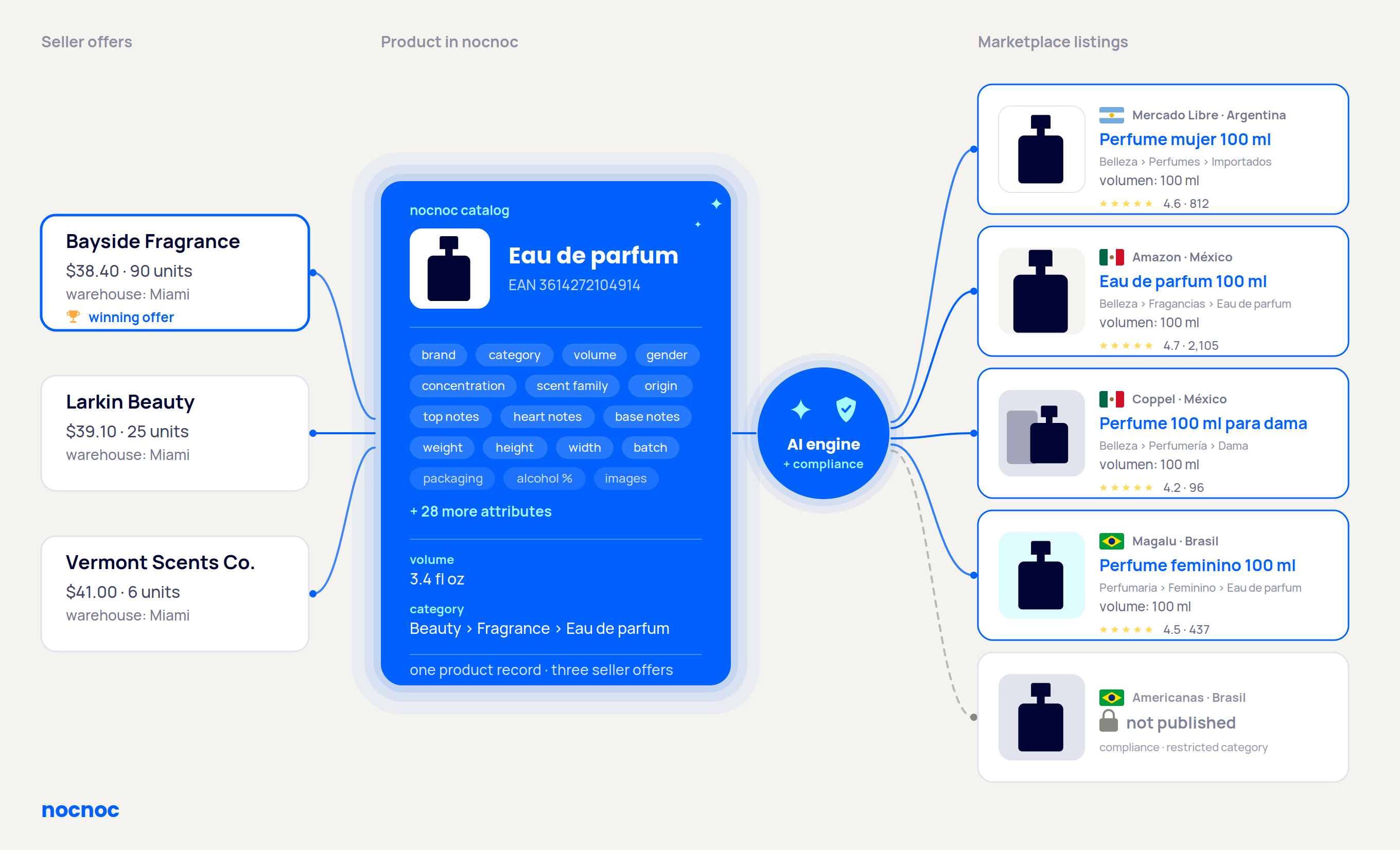
When multiple sellers offer the same product, nocnoc doesn't create a separate listing for each one. Every seller's offer gets attached to a single master product record in nocnoc's internal catalog — and this isn't an edge case: 52% of the products a seller submits already exist in nocnoc's catalog. When that happens, the offer gets associated with the record that's already built, with its own history and positioning, instead of opening a new listing that competes against the one already working.
That means for roughly half of what a seller lists, they're not starting from zero. They're stepping into a listing that may already carry reviews, sales history, and search ranking, instead of competing against it with a brand-new, unranked page.
An internal process decides which seller's offer gets shown on the marketplace at any given moment, weighing business model, fulfillment availability, and price. The product itself never changes — only the offer behind it does. That means winning isn't a small edge: it's taking over the entire listing, with all of its existing traffic and reputation, and capturing every sale that comes through it. It also gives sellers a clear, controllable set of levers — price, fulfillment setup, business model — to compete for that spot, instead of guessing why a listing isn't converting.
Localization that goes beyond translation
Once a product clears compliance, publishing it well means adapting it to how each market actually shops — not just its language, its units, or even its sizing convention. A T-shirt described as "remera" in Argentina becomes "playera" in Mexico, "polera" in Chile, and "camiseta" in Colombia — four words for the same product, all correct, none interchangeable. The same logic runs past clothing: a perfume sells in ounces in the US and milliliters across most of Latin America; a size runs S/M/L in Argentina and P/M/G in Brazil.
Titles aren't just cut down to fit each marketplace's character limit — they're rewritten. Every marketplace has its own limit and its own internal search engine, so the real decision isn't where to trim a sentence, but which attribute can be dropped without costing visibility. Brand, model, size, and color don't carry the same search weight on Mercado Libre as they do on Coppel — it's SEO, just for marketplaces instead of search engines.
Categorization is where this gets genuinely hard. Every marketplace has its own category tree, with thousands of nodes — the same product can land in a different place, under a different name, at a different depth, depending on where it's published. And a category isn't just a label: it determines which attributes become mandatory, and many of those fields don't take free text — they pull from a closed list of accepted values.
Even the simplest attribute breaks this way. Take color: in nocnoc's own catalog, it's been entered in more than 500,000 different variations — "amarillo, "yellow," "Amarillo Claro" — all describing some shade of the same color, none of them written the same way twice. If color, arguably the most basic attribute a product can have, fragments into half a million versions of itself, there's no realistic way to hand-normalize the other 49 attributes across thousands of sellers and 20+ marketplaces. It's not enough to have the right data; it has to be phrased in the exact term that marketplace accepts, or the product gets rejected outright.
That's not something a lookup table can solve. It's thousands of nodes per marketplace, each with its own required fields and closed value lists, and all of it shifts whenever a marketplace decides to change it. So this part runs on an AI engine: it takes the 50 enriched attributes as input, infers where in that category tree the product belongs, generates the attributes that category requires — including ones no external source provided — and normalizes every value to what that marketplace's list actually accepts. The same product comes out as three different listings for three different marketplaces, and none of the three was written by the seller.
Why it matters for sellers
None of this is visible to a seller day-to-day — and that's the point. The operational weight of selling across 20+ marketplaces — each with its own rules, category trees, closed attribute lists, and units of measurement — gets absorbed entirely by nocnoc's catalog engine before a seller ever has to think about it. A seller's job stays down to a handful of fields: a universal code, a title, a description. From there, matching, compliance, categorization, and market-specific phrasing all happen automatically — and if something can't be resolved, nocnoc flags it back instead of leaving the seller guessing why a product never went live.
The upside isn't just less manual work. It's stepping into a catalog that's already built for how each market actually buys — and, when a product is already selling on the platform, stepping into a listing that already has reputation and traffic behind it, instead of starting from zero.
This is the first in a series on the technology behind nocnoc. Next up: how nocnoc's price optimization engine decides what a product should actually sell for — and why the cheapest price isn't always the one that wins.
Automated Product Listing: Frequently Asked Questions
What information does a seller need to provide to list a product with nocnoc?
A universal product code — EAN, GTIN, UPC, or ISBN — along with a title and a description. nocnoc uses that to build the rest of the product record automatically, including up to 50 additional attributes.
How does nocnoc decide where a product can be sold?
Every product is checked against an internal compliance filter that applies each marketplace's and each country's specific rules before publishing, so restricted or non-compliant items are caught automatically rather than published and removed later.
Which marketplaces does nocnoc automate this process for?
Coppel, Walmart, and Mercado Libre currently have the most complete automation for product creation and publishing, with additional marketplaces being expanded over time.